Tag Archives | Organizing Tips

Garage Organization :: Monkey Bars Bike Rack Giveaway & Discount

Planning to organize your garage in the New Year? Typically the best way to keep your garage organized and clean is to get items off the floor. Using the walls and ceiling space to create additional storage options is key and the Monkey Bars garage organization system can help you do it. They offer a versatile shelf-rack system that allows home owners to customize storage solutions based on their needs. I’ve seen it first hand in action and it’s so simple and so brilliant.

garage organization tips

Utilizing a patented design and all-steel components, the Monkey Bars system is designed to last and hold a lot of storage in a little amount of space. They seem to have a solution for most everything including bikes, golf bags, skis, folding chairs, camping gear and gardening tools.
Monkey Bars Garage Organizing System
 If getting your garage organized in on your to do list, you’re in luck!  The nice folks at Monkey Bars are giving away their garage bike rack to one lucky Simplified Bee reader. Sold for $99.99, this wall mounted bike rack is the best way to store bicycles and can be installed in just 15 minutes.
monkey bars bike rack giveaway

 Here’s how to enter to win the garage bike rack:

  • Simply leave a comment on this post (provide your email if I don’t have a way to contact you).
  • Extra Entry – become a new follower of Simplified Bee’s BlogTwitterPinterest or Facebook Page.
  • Extra Entry – mention this giveaway in a blog post, Facebook link, tweet or pin an image from this post, then leave a comment letting me know.
  • Please post a separate comment for each extra entry.

Entry period closes at midnight PST on Wednesday, January 30, 2013. The winner will be chosen by Random.org and will be announced on the Simplified Bee Facebook page on Thursday, January 31, 2013.

garage organizing system

Monkey Bars is also giving all Simplified Bee readers 15% off their products from now until February 6, 2013. Simply use the promo code: BEE2013 Thanks Monkey Bars!

don't agonize, organize.

Happy organizing & good luck!

Cristin


Related Posts Plugin for WordPress, Blogger...
Read full story By on January 23, 2013 in Features, garage organization, Giveaways, Organization, organization tips, Uncategorized

Time Management Tips :: Block It

Time. We never seem to find enough of it. Like many my activities and tacks vary from day to day. Writing, administrative work, on-site consulting, as well as exercising, volunteering and taking care of a busy family are just some of the things I fit into a busy week. Juggling too many activities without boundaries can lead to missed appointments, unhappy customers and frustrated family members. Incorporating time management is something I’ve embraced over the years and have learned many valuable lessons. The number one lesson in time management is to “time block.”


Pink and Orange Apple Clock by Jonathan Adler


{image courtesy of Jonathan Adler}

What is time blocking? Blocking time is essentially setting specific time slots for each activity. It sounds simple, but so many don’t block time for every activity and thus get overwhelmed, distracted and wind up not completing tasks.

Erin Condren Daily Planner 2013 {image via  Erin Condren}

To get started, first you need to pick a unified calendar either online {MS Outlook, Yahoo, Google, etc.} or a traditional {here are my top ten daily planners for 2013}. You can use different colors or buckets for work or life, but one calendar ensures that your obligations don’t get overlooked. If you want your weekends to be time off from work, you should block it into your schedule. Otherwise there is the risk that your work will creep into your personal time. In addition, you should be as specific as you can with your time block schedule.

Still Time to Change the Road You're On
{image via Amy Rice Art}

A benefit from time blocking is it eliminates toggling between tasks. The less we switch tasks, the more focused and efficient our brains can work. Our productivity also improves. It’s important that when you block out time for tasks you remain focused without interruptions {i.e. avoid taking phone calls, etc.}.

Another benefit to time blocking is it stops you from procrastinating. Many of my clients have projects and clutter that is so overwhelming they can’t bring themselves to even start. Instead of tackling the project all at once, it’s best to break the project into smaller, more manageable tasks. Then assign time slots for each task. Remember to assign times during the day that are best for the task and least likely get distracted {i.e. in the morning when the kids are at school, on the weekend when a friend can help, etc.} It’s important that when you block out time for tasks you remain focused without interruptions such as phone calls.

Time Management Quote

Is it time for you to try time blocking?


Related Posts Plugin for WordPress, Blogger...
Read full story By on August 27, 2012 in daily planners, Organization, Organizational tips, time management, Uncategorized

5 Steps to Organize Your Home Office

When it comes to organizing my home, my office seems to always be last on the list of priorities. This year however, stream-lining my home office is high on the list of things to do. Is it on yours? If yes, here are five simple steps to making your office space functional and beautiful…

home office jan showers{image from Jan Showers}

One: De-clutter

Start by removing all clutter. Toss, recycle or donate the items that are broken, not being used or don’t hold any sentimental value. Perhaps all those dried up pens and broken pencils? How about donating that extra calculator to a local school? When is the last time you read or referenced that book? Purging will help fight  exhausting visual clutter in your office and is an easy exercise to perform monthly or quarterly.

organized home office desk
{image from Rue Magazine}

Two: File

Don’t over complicate your filing system. The simpler the better. Think about how you look for a particular file or piece of paper. What would be the easiest way for you to find it?  Then create a file system that works for you. Don’t worry about it being perfect. You can always go back and modify later.

In our home office, I prefer the FreedomFiler – a self-purging file system. It was a recommendation by another professional organizer and now recommend it to my own clients. FreedomFiler has compiled a wonderful {and free} learning center that explains the art of filing successfully.

how to organize home office
{image from Coco+Kelley}

Three: Purge a File or Two

Pick a file drawer and shred all documents that you no longer need to save. Here is quick overview from Bankrate.com of which records you need to keep and which ones your need to toss {shred}:
  • Taxes – Keep seven years. The IRS has three years from your filing date to audit your return if it suspects good faith errors and six years if it thinks you under-reported your gross income by 25 or more.
  • IRA contributions – Keep permanently.
  • Retirement/Savings plan statements – From one year to permanently. Keep the quarterly statements until you receive your annual summary; keep the annual summaries until you retire or close the account.
  • Bank records – Keep from one year to permanently. Throw away checks that have no long-term importance, but keep checks related to your taxes, business expenses and housing and mortgage payments.
  • Brokerage statements – Keep until you sell your securities.
  • Bills – Keep from one year to permanently. In most cases, when you receive the canceled check, the bill can be tossed. However, you should keep bills for big purchases (e.g., jewelry, appliances, cars, collectibles, etc.) for proof of their value in the event of loss or damage.
  • Credit card receipts and statements – Keep from 45 days to seven years. Keep the statements seven years if they document tax-related expenses.
  • Paycheck stubs – Keep one year. If your W-2 form matches your stubs, you can toss your stubs.
  • House/Condominium records and receipts – Keep from six years to permanently.

In addition, its a good idea to create a “life” folder or binder that contains the important legal, medical and financial documents {i.e. will, trust, power of attorney, marriage license, etc.} that family members can access in case of an emergency. The WSJ has comprised a comprehensive list of documents your should include. It is also advised to have a copy of these life documents kept with your attorney or in a safety deposit box at a bank. 

    lonny home office
    {image from Lonny}

    Four: Organize a Desk Drawer

    Desk drawers tend to be dumping grounds. Another way to help streamline your home office is to organize  desk drawers. Start by taking everything out of it and sorting through the contents and placing in groups (i.e. pens, note pads, paper clips, etc.). Items that belong in other areas of the home should go in a box temporarily and put away at a later time. Sort through the contents, donating, recycling or tossing out whatever is no longer useful. 
    Using containers or dividers to corral supplies not only adds function, but can add a touch a style to your desk.  There so many organizing tray and divider options for drawers. Before you purchase any drawer dividers however, measure the drawer {width and height} to know what will fit. Also, keep in mind the sizes and quantities of the items you want to store to ensure you purchase the best option. Once you have decided what works for you, then arrange the office supplies back into the drawer using the different containers or sections of the organizer tray to keep things neat and easy to find.

    eclectic home office organized

    {image from Lonny}

    Five: Stream-line Your Desk Top

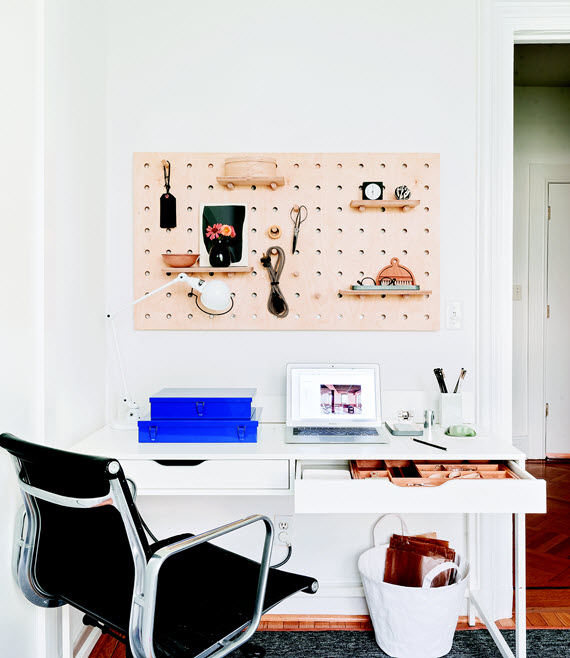
    The easiest way to do this is to remove all items from your desktop except for items that are absolutely necessary for your work (i.e. phone, computer, task light). Determine which items you use on a daily basis (i.e. pen & pencil holder, letter tray) and place them back onto the desk. Add a personal item or two (i.e. family photo, decorative figurine or small plant). The other items that you have removed will need to find a new home (i.e. desk drawer, filing cabinet, recycle bin).

    It might take a few organizing sessions for you to complete all these tasks, but you will be so happy with the results!

    Happy organizing!
    Related Posts Plugin for WordPress, Blogger...
    Read full story By on January 9, 2012 in Decluttering, home organization, office/study, Organization, organization tips

    How to Design an Organized & Stylish Kids’ Playroom

    A dedicated playroom may not be necessary if you live in a moderate climate year-around.  But for those that have to endure long cold winters or heat wave summers,  designing a playroom where kids can “shake their sillies out” is a good idea – not only for them, but you! Here are some tips on  how to design  an organized and stylish playroom:

    Design with Your Child in Mind.
    This may seem obvious, but it is really important to determine what your child likes to do before anything else. Does he enjoy legos, trucks or books? Does she love to paint, sing or play dress-up? Then select items for the space such as an easel, train table or cozy reading chair that will promote their interests. 
    This fun & funky playroom {above} designed by Little Crown Interiors includes a mini black and white laminate dance floor and working disco ball for the future Broadway star. The aqua wall mirror mimics the checkered pattern in the dance floor nicely.  Whimsical custom cabinets are beautifully built to store and organize all those toys.
    {image from Feldman Architecture via Houzz}
    Go Vertical.
    Floor to ceiling shelving helps maximize storage and helps balance a space visually. Check Ikea, Pottery Barn Kids and Room & Board for some great options. Organize the toys in stylish baskets & bins to keep clutter-free and easier to maintain. Favorite age appropriate toys should be kept within reach and on lower shelves to accommodate little ones.

    San Francisco based, Feldman Architecture designed this practical, yet stylish playroom. The floor to ceiling built-in shelves and bench not only maximize storage, but frame the windows beautifully.

    {image from Ore Studios via Design*Sponge}
    Look Down.
    Selecting the right flooring for your playroom is also important. If you have wooden, cement or carpet flooring, layering it with an easy to clean area rug is a good idea. The playroom above designed by Ore Studios showcases colorful carpet tiles from FLOR {child table & chairs from Room & Board}. I have recommended FLOR tiles to clients before and love them because they are washable, interchangeable and are available in a vast array of colors. No nails, glue or padding necessary. Gotta love that.
    {image via Dash & Albert via Posh Tots}
    I am also a hug fan of Dash & Albert woven cotton rugs. They offer tons of colorful patterns including preppy stripes in just about every hue and color combination. Although not used in a playroom, we have a  3′ x 5′ Dash & Albert rug in a high traffic area and cleans up beautifully in the washing machine. 
    Select Petite Furnishings.
    Purchasing the right “kid” size furniture for a playroom is important. Because kids grow up so fast, and pieces may not be used more than a few years, first hit local consignment stores,  flea markets and yard sales for used kid’s furniture. Ebay and Craigslist are also favorite resources for finding inexpensive furniture. Also, don’t be afraid to purchase pieces even if a little beat up. A fresh coat of paint in a color coordinating with the room may be all that is needed.
    Retail stores such as Pottery Barn Kids, Land of Nod and Rosenberry Rooms are also great resources for child’s size furnishings.
     {image via Houzz & Affordable Closet Systems}
    Add Color.
    A playroom by nature is supposed be fun. The colors you select will either energize or calm. Determine how you want the room to feel: Calming or cool colors are often hues blues, greens and violets {most grays included}. Energizing or warm colors are often hues of  red, orange and yellow {browns and tans included}.
    In this playroom above by Affordable Closet Systems horizontal stripes are painted on a slanted wall/ceiling in a cooling blue and green hues. The wide stripe combined with the narrow striping above the custom bookcase creates visual interest and draws our eyes up.
    {image from Allison Cosmos via Houzz}
    Personalize the Space.
    Decorating the walls with framed family photos, vacation spots or pieces of your child’s own artwork is a wonderful way to personalize the space in a playroom.  For those with a particular theme {i.e. jungle, princess, western, etc.} a custom mural or monogram wall decal are also great options.
    Artist, Allison Cosmos recreated the Mad Hatter tea party from Alice in Wonderland in this closet turned playroom. So sweet.
    Bottom line, designing a playroom should be fun, so enjoy the process! 
    Do you have a playroom for your kids or one when you were growing up?
    Related Posts Plugin for WordPress, Blogger...
    Read full story By on September 27, 2010 in baby and children, Design Tips, interior design, Playroom

    Spring Cleaning Tips: Making Your Closet Functional & Beautiful

    Keeping a house clean is a year around task, however many bigger cleaning projects are saved for when the seasons change. Washing windows, cleaning upholstered furnishings and washing outdoor furniture many be some chores on your spring cleaning checklist. Getting your closet organized is also an important task as we go into spring and here are a few tips to help you get started:

    Store. As you transition your wardrobe closet from cold-weather clothing to warm-weather clothing, make sure that you store sweaters, coats and pants away in zipped bags that protect your garments from moths and other pests. And before you store, make sure your garment is cleaned. The Container Store has some great storage options and a spring organization sale going on now.

    Give. Donate clothing that you do not wear to a local charity. Don’t know one in your area? Excess Access will match you with a charity organization in your zip code. They link each donation with the wish-lists of your nearby charities that can provide pick-ups or will accept drop-offs. And donors get tax-deductible receipts.

    Organize. If you have a large or walk-in closet it’s best to organize it into zones by season or garment type (i.e. work, casual, formal). Next arrange the clothing into sections for each category (i.e. blouses, dresses, pants, etc.). Then arrange the clothes in each section by color from left to right (i.e. black, blue, brown, red, orange, yellow, ivory and white). This makes it much easier to find outfits and is more pleasing to the eye. Wouldn’t you agree?

    Function & Style. To help keep shirts, shoes and sweaters arranged neatly I recommend stackable boxes with clear fronts like these tweed drop-front boxes. The clear drop-front allows you see what’s inside and to access items without having to unstack them.

    Plan. The Today Show recently highlighted Closet Lite, a high-tech clothing organization/planning application for your iPhone. It allows you to organize your clothing, create outfits, plan them for certain days and view them. This app can even create packing lists for any upcoming trips. Love this!

    Speaking of trips – are you taking a vacation for spring break? If so, here are some more tips on packing for a trip.

    Happy spring and happy organizing!

    *images courtesy of House Beautiful, Martha Stewart, Canadian House & Home, Making it Lovely

    Related Posts Plugin for WordPress, Blogger...
    Related Posts Plugin for WordPress, Blogger...
    Read full story By on March 31, 2010 in Closets, home organization, household cleaning, Organization, organization tips, storage, travel tips